
The Startup Column: Reassessing the Startup Ecosystem of Taiwan’s Six Major Cities – Tainan
As Taiwan’s oldest cultural capital, Tainan is undergoing a profound structural transformation amid global supply chain realignment and digitalization. Unlike northern metropolitan areas, where startup activity is largely driven by software, internet services, and business model innovation, Tainan’s entrepreneurial ecosystem is anchored in six major industrial parks that together form an integrated innovation hub. These parks provide space, R&D resources, validation environments, and industrial networks that support the rapid growth of startups.
As Taiwan’s oldest cultural capital, Tainan is undergoing a profound structural transformation amid global supply chain realignment and digitalization. Unlike northern metropolitan areas, where startup activity is largely driven by software, internet services, and business model innovation, Tainan’s entrepreneurial ecosystem is anchored in six major industrial parks that together form an integrated innovation hub. These parks provide space, R&D resources, validation environments, and industrial networks that support the rapid growth of startups.
The presence of leading semiconductor manufacturers, including advanced process investments by Taiwan Semiconductor Manufacturing Company (TSMC), has generated a strong industrial cluster effect. This has reinforced Tainan’s core strength in hardware-driven technology development and manufacturing upgrades. Beyond attracting significant capital investment and employment opportunities to the region, it has also accelerated industrial upgrading in related sectors such as precision machinery and optoelectronic materials.
As a result, Tainan’s startup landscape has developed a unique two-track structure. On one track, technology-driven ventures focus on supply chain optimization, equipment development, and smart manufacturing solutions tailored to the needs of high-tech manufacturing industries. On the other, cultural and creative startups draw on the city’s rich cultural foundations while integrating digital content with lifestyle elements. The interplay between industrial capabilities and cultural strengths, combined with relatively affordable living costs, has gradually positioned Tainan as a distinctive innovation hub within Southern Taiwan’s emerging technology corridor.
1. An Integrated Industry-Government-Academia Support System
In response to the growing need for transformation and professionalization within the entrepreneurial support sector, 24 incubation and startup development organizations across Chiayi, Tainan, Kaohsiung, Pingtung, and Penghu jointly established the Greater South Innovation and Incubation Promotion Association (GSIPA) in 2022. Led by practitioners and managers in the field, the association seeks to strengthen the overall startup support infrastructure in southern Taiwan through institutional coordination. Its key priorities include cultivating local talent, facilitating cross-disciplinary resource integration, and fostering an entrepreneurial culture on university campuses. The initiative has become an important source of technical expertise and a talent pipeline for startups across the region.
At the policy and research level, the Shalun Smart Green Energy Science City (SSGESC), a central government initiative, brings together leading national research institutions, including the Industrial Technology Research Institute (ITRI) and the National Institutes of Applied Research (NIAR). The park provides a comprehensive demonstration environment for green energy technologies, enabling startups to conduct critical technology validation.
The Tainan City Government has also taken an active role in supporting startup hubs and incubation platforms, including the Win Win Innovation and Incubation Base, the STSP Startup Workshop, Fablab STMC, the STIR Startup Hub, and the TTA South. Through entrepreneurship competitions and matchmaking events, the city government acts as a bridge connecting startup teams with traditional local industries and their resources.
2. Technology R&D Clusters in Green Energy, Biomedicine, and the Semiconductor Supply Chain
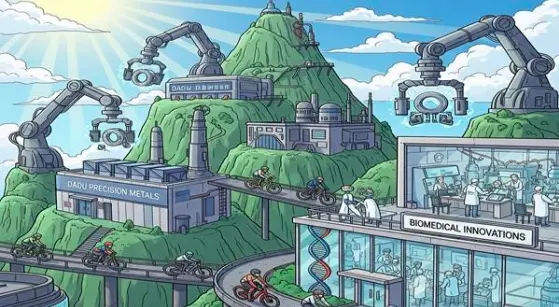
Benefiting from its established industrial base and policy support, Tainan’s startup ecosystem demonstrates a clear focus on technology R&D and industrial applications. Key areas include green energy, biomedicine, and the semiconductor supply chain.
In the green energy sector, a number of startups have established a presence at the Shalun Smart Green Energy Science City (SSGESC), focusing on R&D and demonstration projects in solar power, energy storage systems, hydrogen technologies, and smart grids. In the biomedical field, supported by the extensive medical, academic, and research resources of institutions such as National Cheng Kung University Hospital, the local ecosystem has fostered startups specializing in advanced medical devices, precision diagnostics, and smart healthcare platforms.
At the same time, the semiconductor cluster surrounding the Southern Taiwan Science Park has led to the emergence of technology-oriented startups providing smart manufacturing solutions, inspection equipment, and critical materials. The region is also home to startups leveraging local agricultural strengths to develop smart agriculture solutions, as well as cultural and creative ventures that integrate elements of local heritage. Overall, startups in Tainan tend to demonstrate higher technological intensity and longer R&D cycles.
3. Strengthening Industry Linkages to Build a Mature Technology Innovation Hub
Driven by the strong momentum generated by the Southern Taiwan Science Park, Tainan is accelerating its transition from a historic cultural capital into a high-tech industrial city. The current priority is to translate this potential into sustained competitive advantage. Key measures include establishing effective coordination mechanisms that promote deeper integration between leading firms in industrial parks and local startup communities, creating an ecosystem where leading companies drive the growth of smaller ventures while fostering shared prosperity across the industry.
Meanwhile, greater participation from private venture capital firms and angel investors will be essential to channel early-stage funding into southern Taiwan’s startup market. Together with continued improvements in urban livability, these efforts are expected to attract and retain mid- to senior-level technical and managerial talent. With deepening industry-academia-research collaboration and a maturing capital environment, Tainan is poised to further consolidate its position as a mature and distinctive technology innovation hub within Taiwan’s broader startup landscape.