
The Startup Column: Reassessing the Startup Ecosystem of Taiwan’s Six Major Cities –Taoyuan
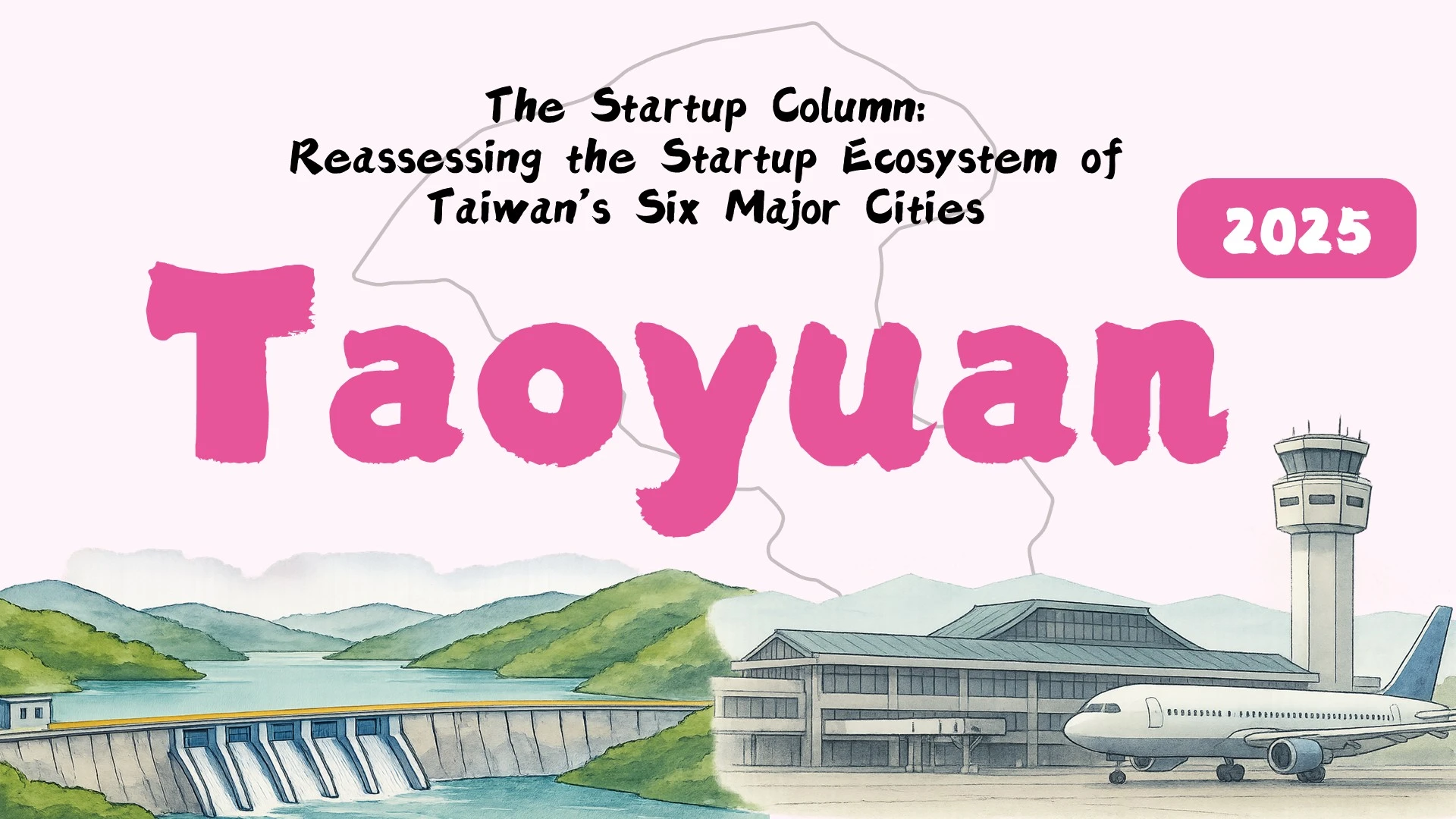
Based on demographic distribution, lifestyle patterns, and industrial development, Taoyuan City can be divided into two core regions, Northern Taoyuan and Southern Taoyuan. Northern Taoyuan serves as the city’s central hub and primary residential area, and Southern Taoyuan, centered around Zhongli District, forms part of the Taoyuan, Hsinchu, and Miaoli living sphere.
1. Introduction
Based on demographic distribution, lifestyle patterns, and industrial development, Taoyuan City can be divided into two core regions, Northern Taoyuan and Southern Taoyuan. Northern Taoyuan serves as the city’s central hub and primary residential area, and Southern Taoyuan, centered around Zhongli District, forms part of the Taoyuan, Hsinchu, and Miaoli living sphere.
In recent years, Taoyuan’s rapid development has been driven by its geographical advantage as a neighboring city to the Taipei metropolitan area, along with major public infrastructure projects and increased corporate investments. In addition, the presence of Taiwan’s largest international airport has accelerated population inflows from other counties and cities and has contributed to the continued growth of the Taoyuan-Zhongli metropolitan area.
As one of Taiwan's key industrial strongholds, Taoyuan hosts 37 industrial parks and leverages advanced instruments and smart platforms to monitor their operations. This strong industrial foundation has attracted a large number of migrant workers from Southeast Asia, making Taoyuan the municipality with the largest foreign workforce in Taiwan. The city is also home to the largest Vietnamese immigrant community in the country, which highlights its multicultural character and reflects the contribution of diverse communities to Taoyuan’s prosperity and development.
Taoyuan consistently ranks first in Taiwan in terms of industrial output and encompasses a full spectrum of sectors that range from traditional manufacturing to high-tech industries. These sectors include logistics, optoelectronics, high-tech manufacturing, aerospace, automotive components, biotechnology, agriculture, green energy, and other related fields. Together, these industries form a comprehensive industrial cluster that supports Taoyuan’s vision of becoming a smart technology city.
In 2024, as the Asia Silicon Valley Development Plan entered its 3.0 phase, the National Development Council introduced the “Taoyuan-Hsinchu-Miaoli Greater Silicon Valley Development Plan” in February of the same year to jointly promote emerging technology industries. The initiative links Taiwan’s six core strategic industries and the Chip-based Industrial Innovation Program and aims to connect the regional technology hubs and industrial parks across Taoyuan, Hsinchu, and Miaoli. By integrating the supply chains of the semiconductor industry and other technology sectors, the plan seeks to build an innovative and sustainable high-tech cluster that encourages cross-industry collaboration and long-term growth.
With the combined efforts of industry, government, and corporations, Taoyuan’s position in the StartupBlink Global Startup Ecosystem Index improved from 341st worldwide to 325th in 2024, placing the city third among all cities in Taiwan. Against this backdrop, this article examines how Taoyuan’s startup ecosystem has emerged within a thriving entrepreneurial environment and analyzes the defining features of its development. The following sections present key elements of Taoyuan’s startup ecosystem through illustrative visuals and data and offer an overview of its current stage of development.
2. Industry–Government–Academia–Research Collaboration: Building Taoyuan’s Comprehensive Startup Incubation Ecosystem
Within an innovation and startup ecosystem, entrepreneurial support organizations play a critical role by providing startups with essential resources and assistance. These organizations offer office space and shared facilities, professional guidance and financial support, and help establish market connections. Such support enables startups to grow more rapidly, mitigates the risks and uncertainties typically encountered during the early stages, and increases their likelihood of success, thereby contributing to the overall development of the startup ecosystem.
In terms of startup hub, the Youth Entrepreneurship Command Center provides coworking space, makerspace functions, private offices, entrepreneurial guidance, resource matching, customized mentorship programs, networking events, and cross-district exchange activities. The Andong Startup Hub focuses on XR, the metaverse, blockchain, multimedia gaming, and digital audiovisual content applications and operates an XR Experience Center to explore XR technologies and their applications.
Accelerators deliver structured programs that accelerate the growth of startups through funding, entrepreneurial training, mentorship, proof-of-concept validation, funding matchmaking, and networking opportunities. The Taoyuan City Skyline Accelerator supports mid- to late-stage startup teams in digital economy, smart IoT, fintech, biotechnology and healthcare, green technology, and ESG solutions, providing domestic and international entrepreneurial resources, partnership opportunities, professional consulting services, one-on-one customized mentorship, international funding matchmaking, and subsidies for domestic and overseas exhibitions. The Taoyuan Smart Industry Accelerator (TSIA) supports early- to mid-stage startups in AI-driven digital transformation, smart manufacturing, smart healthcare, and green technology, adopts the Corporate Startup Engagement (CSE) model, facilitates connections between startups and traditional enterprises, promotes industrial upgrading, and integrates domestic and international resources within the AI Golden Industrial Corridor. LANDSEED HALL+ concentrates on smart healthcare, digital health, technology-assisted therapy, and senior fitness, leveraging medical resources to provide accelerated clinical and service validation and support new product development. Plug and Play established a branch in Taoyuan in May 2025 to help Taiwanese startups grow from the early stage, scale operations, introduce international startups, and connect with Silicon Valley and global markets.
Incubation centers affiliated with academic and research institutions are integrated through the Taoyuan Campus Entrepreneurship Alliance, which brings together 13 universities and colleges under a “one university, one specialty” approach and organizes competitions such as the Taoyuan Startup Star Competition and the Startup Star Performer Competition to provide funding programs, venture capital matchmaking events, PoC validation, and market expansion opportunities.
According to registration data from the Ministry of Economic Affairs, 43 venture capital institutions with registered company addresses in Taoyuan had participated in investment deals as of February 2025. Overall, Taoyuan’s strategic investment institutions, supported by strong industrial backgrounds, play an active role in startup investment and cross-industry collaboration. They not only contribute capital to the local startup ecosystem but also leverage technical expertise and market resources, positioning Taoyuan as an important hub for innovation and industrial upgrading in Taiwan.
Coworking spaces such as Fortune Star Business Center and Take A Seat Coworking Space provide environments where entrepreneurs can exchange ideas, collaborate, and develop new business concepts. Beyond offering workspace, they provide comprehensive support such as office equipment, meeting rooms, reception areas, and company registration services.
Government programs including the Taoyuan Sports Tech Startup Accelerator provide expert mentorship, Demo Day pitch competition, grants, and funding support to engage with venture capital firms in Silicon Valley, collectively strengthening Taoyuan’s startup ecosystem and international competitiveness.
3. Taoyuan Startup Ecosystem – Outstanding Startups
The development of startups in Taoyuan City generally mirrors the overall trend in Taiwan. The number of new startups peaked in 2018, when 64 startups were founded. Since then, the number of newly established startups has gradually declined, reflecting not only a cooling of the entrepreneurial boom but also the impact of the COVID-19 pandemic in 2020, which slowed startup growth. In recent years, however, Taoyuan City has actively promoted innovation and entrepreneurship by integrating central and local resources to create a supportive environment for startups and stimulate local entrepreneurial activity. Although the number of newly founded startups temporarily decreased due to external factors such as the pandemic, the long-term trend shows steady growth in the overall number of startups in Taoyuan.
As of February 2025, FINDIT statistics indicate that Taoyuan is home to 573 startups. The five districts with the highest numbers are Zhongli District (140), Taoyuan District (104), Luzhu District (70), Guishan District (61), and Pingzhen District (50). Together, these districts account for 425 startups, or approximately three-quarters of the total, indicating a highly concentrated distribution of startup activity in Taoyuan, particularly in Zhongli and Taoyuan Districts, as shown below.
Among the 573 startups in Taoyuan City, the Manufacturing sector has the largest share, with 77 startups, accounting for 13.44%. The second-largest sector is Hardware, which includes semiconductors, communications, and other hardware-related fields, with 66 startups representing 11.52%. This is followed by Consumer Goods with 51 startups (8.9%) and Health Care with 47 startups (8.2%). Food & Beverage and Energy are tied for fifth place, each with 34 startups, accounting for 5.93% respectively. Together, these top five sectors make up 53.93% of all startups in Taoyuan. Other sectors with more than 20 startups include Sustainability and Transportation.
As one of Taiwan’s major industrial hubs, Taoyuan has a strong concentration of startups in manufacturing-related industries, where they can enhance their market competitiveness by leveraging the city’s well-established industrial infrastructure and resources. Moreover, these startups not only benefit from Taoyuan’s robust industrial base but also help attract more investment and talent, further driving regional economic development.
4. Conclusion and Insights
Taoyuan’s startup ecosystem demonstrates a diverse range of industrial development, particularly in the manufacturing, hardware, and healthcare sectors. Leveraging its geographical advantages, efficient logistics, and strong industrial clustering, local startups are able to reduce costs, enhance operational efficiency, and benefit from the integration of talent, technology, and capital. Since Mayor Chang San-Cheng took office in 2022, the local government has further strengthened this momentum by actively promoting entrepreneurship, providing funding and guidance to startups, and fostering a supportive environment for their growth.
Looking ahead, with strong support from the local government, Taoyuan has established a clear direction for industrial development. Driven by global trends such as digital transformation, ESG, and the 2050 net-zero emissions goal, the Department of Youth Affairs of the Taoyuan City Government recently signed a memorandum of understanding with The Circle: Founders Club, a globally renowned accelerator. This partnership aims to strengthen ecosystem linkages, enhance collaboration with global innovation resources, and promote international exchanges and resource sharing, thereby improving the international competitiveness of local startups.
Taoyuan, once constrained by relatively limited private-sector resources, is now gradually transforming into an innovation hub with strong industry-academia collaboration, clear industrial positioning, and expanding international networks. As technology continues to advance and market demands evolve, Taoyuan is expected to maintain growth in areas such as smart manufacturing and green technology, further solidifying its role as a driving force in Taiwan’s startup ecosystem.