

[ 2025 Taiwan Startup Investment Trends Annual Report – Green Energy ] Cultivating Resilience in Stillness, Building a Solid Foundation
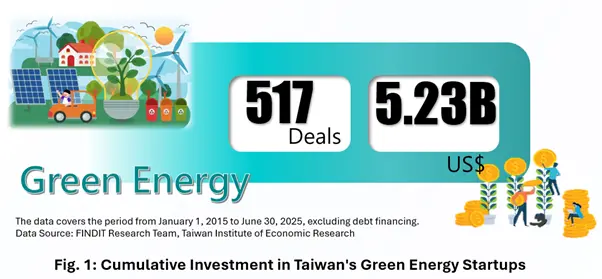
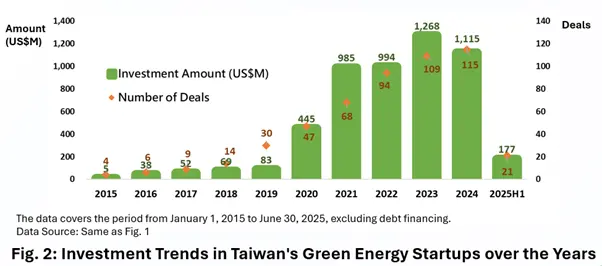
Taiwan’s green energy startup ecosystem has continued to expand, driven by policy initiatives and growing corporate demand. The sector spans a wide range of domains, including solar energy, energy storage, hydrogen energy, geothermal energy, and Waste-to-Energy. In 2024, total investment declined to US$1.11 billion, down 12% year-over-year and marking the first contraction since 2015. Despite this slowdown, several startups strengthened overall industry resilience through technological innovation and international expansion. The following sections highlight representative funded companies and key trends in 2024.
Taiwan’s green energy startup ecosystem has continued to expand, driven by policy initiatives and growing corporate demand. The sector spans a wide range of domains, including solar energy, energy storage, hydrogen energy, geothermal energy, and Waste-to-Energy. In 2024, total investment declined to US$1.11 billion, down 12% year-over-year and marking the first contraction since 2015. Despite this slowdown, several startups strengthened overall industry resilience through technological innovation and international expansion. The following sections highlight representative funded companies and key trends in 2024.
Solar Energy: Internationalization, Scale-Up, and One-Stop Green Energy Service Opportunities
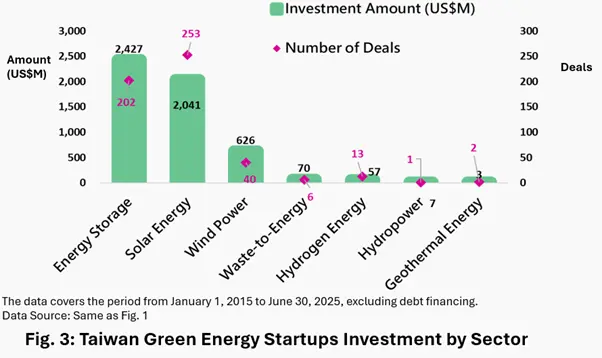
Since 2015, the solar energy subsector has accumulated US$2.04 billion in investment, making it one of the most well-funded and relatively mature segments within Taiwan’s green energy startup landscape, with several companies already publicly listed. In 2024, startups continued to expand both their international footprint and business scope. GreenRock Energy, for example, has actively entered overseas markets through international partnerships. In Japan, some of its projects have begun generating stable revenue from electricity sales. In Malaysia and Vietnam, the company is collaborating with businesses and government agencies to advance large-scale solar projects and deliver smart energy solutions, serving Taiwanese companies operating abroad as well as major power consumers.
In parallel, Ina Energy has expanded into Australia to develop power plants and hydrogen energy projects, while partnering with Japan’s Daiwa on biomass initiatives. It is also evaluating further expansion into Vietnam, the Philippines, and Japan. Meanwhile, Aqua Star Energy and Likees Tech-Service have secured investments from HD Renewable Energy, Acer, and Taiwan Life Insurance, and are actively developing integrated green energy service models that combine power generation, energy storage, and electricity sales.
Energy Storage: Technological Advancement and Innovative Applications Leading Globally
Energy storage has accumulated US$2.43 billion in investment in Taiwan’s green energy startups since 2015. Since 2022, it has surpassed solar energy to become the most heavily invested sector in this field.
APh ePower focuses on aluminum -ion (Al-ion) battery technology and is the first company globally to commercialize aluminum battery energy storage solutions. Its “Energy Saving Through Elevator Regenerative Power System Implementation” has been certified by Gold Standard. By recovering kinetic energy from elevators, the company reduces electricity consumption by over 40% and helps users generate carbon credit revenue.
Meanwhile, Sino Applied Technology (SiAT) has partnered with China Petrochemical Development Corporation (CPDC) to develop LMPZD safety additive slurry, which effectively mitigates the risk of thermal runaway in lithium-ion batteries. The company has also secured investment from Japan’s ZEON to advance single-walled carbon nanotube materials, enhancing battery conductivity, lifespan, and safety while targeting high-end markets. In addition, Largan Energy Material, a joint venture between ITRI and Largan Precision, has launched the world’s fastest-charging titanium niobium oxide (TNO) anode materials, capable of a full charge in five minutes and offering a lifespan of up to 20 years, targeting applications in electric vehicles and energy storage.
Hydrogen Energy: Accelerating Commercialization of Hydrogen-Blended Fuel Cells and Hydrogen Production Technologies
Hydrogen energy is a key focus of Taiwan’s green energy policies. In 2024, investment momentum strengthened as both technologies and business models continued to mature. Blade Hydrogen Green Technology, a spin-off from ITRI, has developed hydrogen-blended fuel cell generators that convert waste hydrogen from semiconductor processes into clean energy. The company has helped clients obtain the world’s first hydrogen-based green power certificate and plans to expand into transportation vehicles and hydrogen refueling stations in the future.
Meanwhile, Stellar Power System, a subsidiary of Chung Hsin Electric & Machinery (CHEM), focuses on hydrogen fuel cells for transport vehicles and is planning to expand into Southeast Asia and India. Nexcellent Energy provides hydrogen fuel cell OEM/ODM services, covering power generation systems, in-vehicle applications, membrane electrode assemblies, and energy storage solutions. In parallel, H2 Energy specializes in hydrogen production and has partnered with Japan’s Hydrogen Technology to introduce a “natural ore + water” hydrogen production technology that operates at ambient temperature and pressure, producing high-purity hydrogen with a purity of over 99.999% while ensuring both safety and scalability.
Highlights in Emerging Fields: Geothermal Energy and Optoelectronics Industry Regeneration and Recycling
The year 2025 is often described as Taiwan’s “first year of geothermal development,” with exploration technologies and service providers gaining increasing attention. 3JTech has introduced a magnetotelluric exploration system, while CPC Corporation has invested NT$3.4 billion in geothermal exploration. In parallel, Google has signed geothermal power purchase agreements, and Skwentex Energy is collaborating with National Taiwan University on deep, high-temperature drilling technologies, gradually overcoming technical constraints.
At the same time, the growing volume of end-of-life solar panels is creating new opportunities for recycling and material recovery within the circular economy. RePV Tech, established through a technology transfer from ITRI, specializes in the high-purity recycling of silver, glass, and silicon from decommissioned solar panels, providing low-carbon recycled materials and carbon credit management. With support from Japan’s Kankyo Hozen, the company aims to build a low-carbon solar ecosystem.
Meanwhile, Acon Greenergy Technology converts waste solar panels silicon from into anode material for lithium-ion batteries. UWin Resource Regeneration has developed patented low-carbon lithium-ion battery recycling technology for safe and environmentally friendly processing, with plans to export turnkey solutions to Europe, the United States, Japan, and Indonesia. In addition, Beyond Zero Recycling Technology uses patented technology characterized by low energy consumption and high safety to recover high-purity nickel, cobalt, and copper through an integrated process.
Five Transformations Development: Fortifying Taiwan’s Long-term Green Energy Resilience
Taiwan’s green energy startups are advancing in five major directions: scaling up (building one-stop green energy services), internationalization (expanding presence across Asia and global markets), technological deepening (achieving key breakthroughs in batteries, hydrogen energy, and geothermal), supply chain enhancement (promoting circular regeneration of photovoltaic panels), and green energy diversification (hydrogen energy and geothermal).
Despite challenges such as land scarcity, environmental protests, and shifts in U.S. green energy policies, Taiwan’s green energy startups are expected to continue deepening the Five Transformations Development, supported by the government’s Energy Policy 2.0, improved dispute resolution mechanisms, diversified green energy strategies, corporate RE100 commitments, and the massive green electricity demand driven by AI. These efforts will inject strong momentum into Taiwan’s energy transition and net-zero goals.

![[Taiwan Startup Investment Watch] Notable Deals, Mar-Apr 2026](https://findit.org.tw/Files//ResArticle/e01ad1c3-a408-4307-bc8b-3fb280c63396.webp)
![[ 2025 Taiwan Startup Investment Trends Annual Report – Investors ] Momentum Converges: Capital Moves to Mid-Stage as Startup Investment Stabilizes](https://findit.org.tw/Files//ResArticle/83d713c0-c984-48d7-9f94-af4118abfed5.svg)
![[Taiwan Startup Investment Watch] Notable Deals, Jan-Feb 2026](https://findit.org.tw/Files//ResArticle/b5f74fc8-7d07-498b-8e94-7c1ba440a5ea.webp)
![[Taiwan Startup Investment Watch] Notable Deals, Nov-Dec 2025](https://findit.org.tw/Files//ResArticle/a7e321a7-9b78-4225-9035-1a1c4ee55906.webp)
![[Taiwan Startup Investment Watch] Notable Deals, Sep-Oct 2025](https://findit.org.tw/Files//ResArticle/bcb29b6d-b33c-4966-bb6b-45bbb3c7c334.webp)
![[Taiwan Startup Investment Watch] Notable Deals, Jul-Aug 2025](https://findit.org.tw/Files//ResArticle/19571573-b31e-4a41-ba23-deccc005ece3.webp)