
[ 2025 Taiwan Startup Investment Trends Annual Report – AI ] AI Is No Longer a Mystery, It Is Part of Everyday Life
Since 2023, artificial intelligence (AI) has advanced rapidly, with its influence extending beyond academia and industry into everyday life, where it is increasingly adopted as a practical tool. Although concerns about a potential market bubble emerged in 2024, continued strong startup investment activity and sustained public attention suggest that AI momentum remains intact. As large-scale models and infrastructure continue to drive industry expansion, AI applications have become firmly established. By 2025, both tools and investment activity remain robust, indicating increasing industry maturity and a gradual concentration of capital.
1. Momentum Continues: Taiwan’s AI Investment Keeps Pace with Global Trends
As the surge in AI enters its third year, Taiwan’s AI industry is moving from a broadly defined landscape toward a more structured industry. As market expectations shift from technological demonstrations to tangible monetization and real-world outcomes, Taiwan is well positioned to capture this transition, supported by its strong semiconductor base and hardware capabilities.
Despite lingering skepticism, AI technologies are already reshaping industries at a fundamental level. The share of global investment allocated to AI has continued to rise year by year, with Taiwan’s investment trends closely tracking this trajectory. Capital inflows remain robust, suggesting that Taiwan’s AI startup ecosystem is entering a phase of accelerated growth, driven by its hardware strengths and expanding from infrastructure into applications.
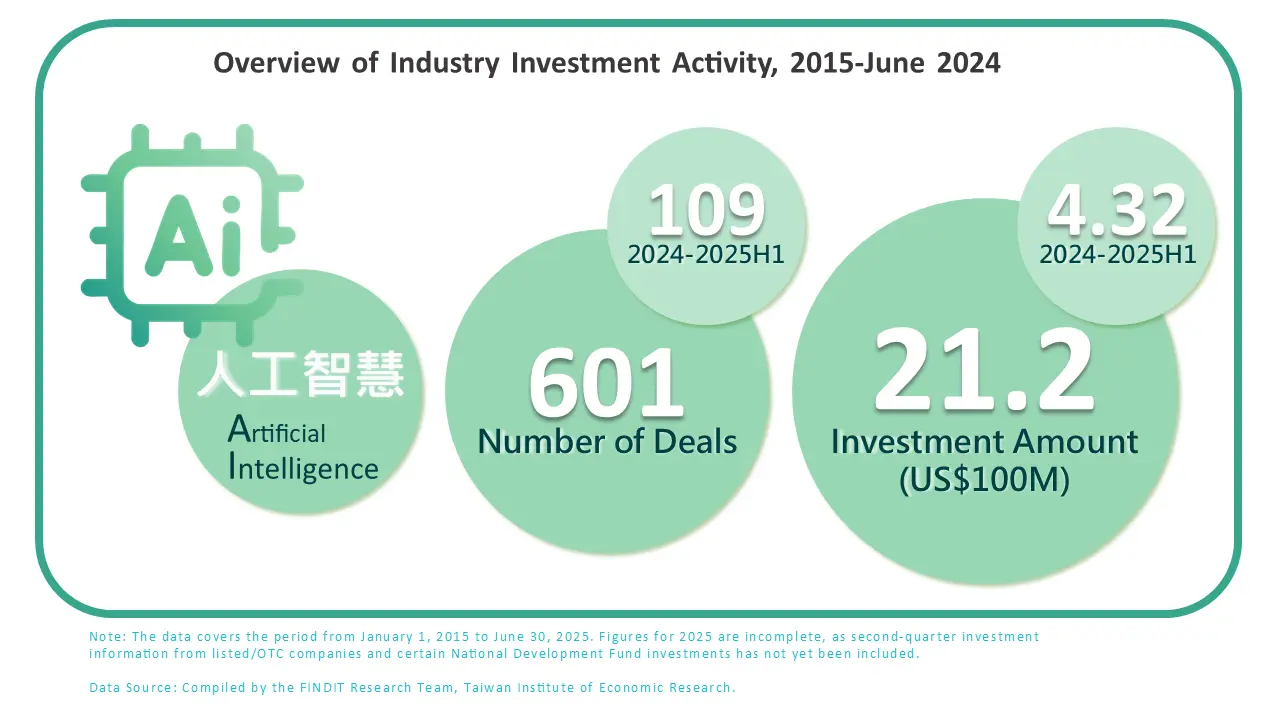
Globally, AI investment activity has remained resilient despite broader market headwinds. In Taiwan, according to the FINDIT Research Team, a total of 601 AI-related deals were recorded between 2015 and Q2 2025, accounting for 13.04% of all startup deals, with total funding reaching US$2.12 billion, representing 11.16% of the overall market. Among these, vertical AI applications made up the largest share, with US$1.04 billion in funding across 291 deals.
2. AI Applications That Meet Real Industry Needs Stay in the Spotlight
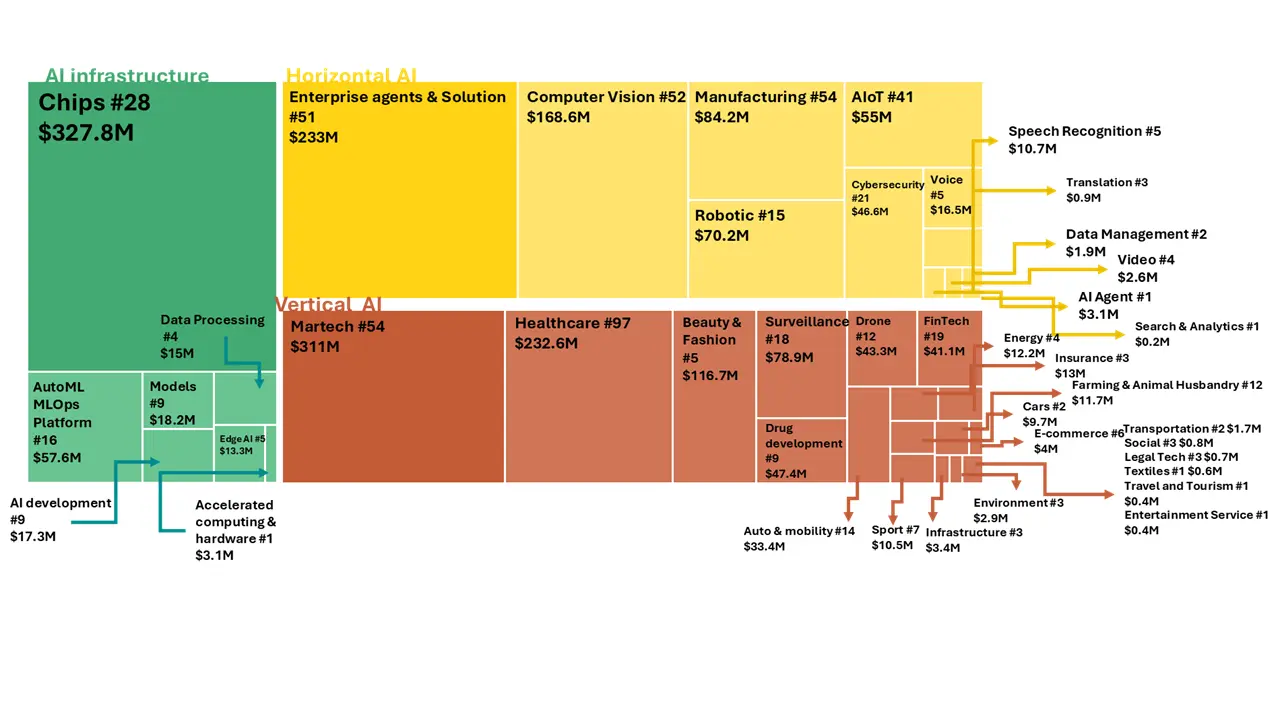
Overall, AI chips continue to account for the largest cumulative investment amount, with 28 deals totaling US$328 million. However, compared with the previous year, deal activity in this segment has shown limited growth. By deal count, within vertical AI, health care ranked first with 97 deals, followed by marketing technology (martech) within the same subsector and manufacturing within horizontal AI, each with 54 deals.
2.1 Vertical AI: The Only Subsector with Growth in Deal Counts from 2023 to 2024
Within this subsector, health care remained the most active segment, leading in deal count. Application areas range from optimizing diagnostic workflows and enabling smarter medical devices to more advanced use cases such as drug discovery and precision medicine. Martech has also benefited significantly from the widespread adoption of generative AI, emerging as the leading segment in terms of total funding. As AI-powered image recognition and autonomous navigation technologies continue to mature, applications such as drones, autonomous driving systems, and surveillance equipment have established a stable presence in the market.
2.2 Horizontal AI: Manufacturing Applications Continue to Lead
As a global manufacturing hub, Taiwan continues to see strong momentum in smart manufacturing applications, including supply chain management and process optimization, which remain the leading segment within horizontal AI. At the same time, AI agents are emerging as a key trend for 2025, reflecting the growing ability of AI systems to autonomously execute tasks and optimize decision-making, rather than serving solely as assistive tools.
AI adoption is broadening, driving increased enterprise demand for cybersecurity and digital transformation services. Solutions addressing ESG requirements, carbon accounting platforms, and conversational AI products powered by natural language processing (NLP) are becoming central to horizontal AI.
2.3 AI Infrastructure: Higher Standards Driven by AI Application Development
Between 2023 and 2024, both deal count and investment value in AI infrastructure declined slightly. Momentum, however, rebounded from 2024 through the first half of 2025, with total funding doubling over this period. The most notable growth was observed in AI chips and edge AI.
AI chips continue to account for the largest share of total funding. As industry expansion accelerates, infrastructure is becoming an indispensable foundation. Beyond development, achieving a balance between performance and cost, as well as thermal management, remain critical challenges. Taiwan’s strengths in semiconductors and hardware manufacturing place it in a favorable position to capture these opportunities.
3. Conclusion
Compared with global AI developments, Taiwan may appear slightly behind in the pace of technological iteration and the emergence of new trends. Nevertheless, its overall investment level and trajectory remain broadly aligned with global patterns. According to the FINDIT Research Team, Taiwan recorded 75 early-stage AI investment deals in 2024, in line with 2023 levels, although total investment value declined by approximately US$20 million to around US$284 million.
Across the three major subsectors, AI infrastructure and horizontal AI are gaining a larger share of investment. By leveraging its existing strengths, Taiwan’s startup ecosystem is well positioned to continue generating new investment hotspots.
Looking ahead, Taiwan will continue to play a critical role as a global supplier of computing power. However, technological breakthroughs alone are not sufficient. Sustained progress will require coordinated efforts across government policy, enterprise transformation, and talent development to build a comprehensive AI ecosystem. Only when advances in technology are closely integrated with digital transformation at the application level can AI realize its full potential in Taiwan and drive the next wave of industrial growth.